

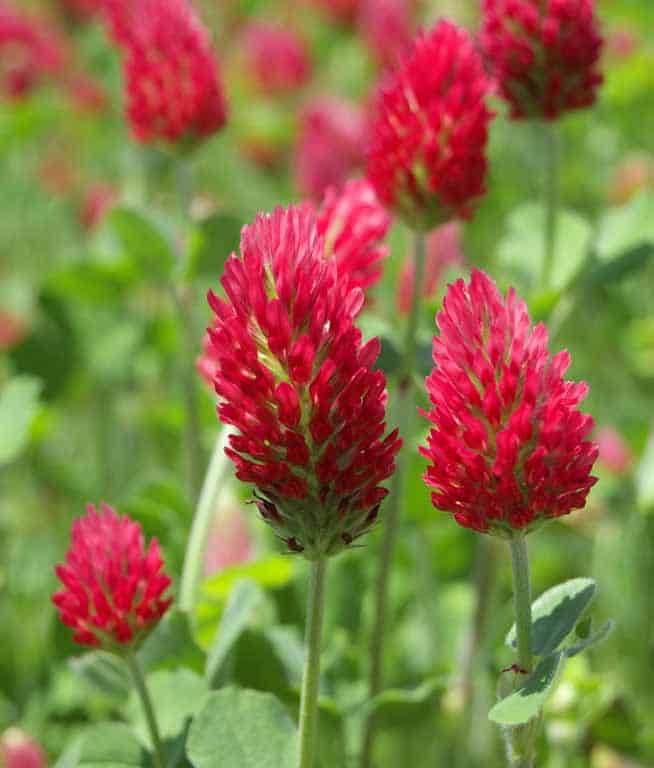
Freezing winter weather, hot summer sun, and high temperatures can wreak havoc on the soil in vegetable gardens. Cover crops not only protect the soil from weather extremes but are also used between crops to restore fertility, suppress weeds, or protect or restore a garden bed left unplanted for a season. They can also be used to reduce fertilizer use, restore or trap nitrogen, and improve soil and water quality.
Before the invention of synthetic fertilizers, cover crops were planted in-between harvests to scavenge and store nitrogen and other elements, preserve soil structure, slow water runoff and evaporation, protect garden beds from erosion, and suppress weed growth. It’s a sustainable method overlooked by many home gardeners but is widely used in organic agriculture.
Many gardeners see Fall as the end of the gardening season – they pick the last of their tomatoes, peppers, and beans and put a lid on it. But Fall is a critical season for your vegetable garden beds, as they need to be protected from the coming winter weather. You’ve probably also seen what harsh summer weather does to open spaces between your vegetables – cracked, dry, hard-baked soil. The best way to protect your garden beds from these weather extremes is by planting a cover crop, also known as “green manure”.

[su_highlight background=”#fef7a1″]Buy on Amazon: Mountain Valley Seed Company Cover Crop Seeds
What are examples of cover crops?
Cover crops are primarily legumes, grasses, and brassicas and include oats, buckwheat, vetch, beans, peas, daikon radishes, tall fescue, winter peas, forage radish, mustards, clover, barley, ryes, sudangrass and many more. Which cover crop you should plant depends on your region and purpose: protecting beds from erosion, suppressing weeds, or restoring fertility.
Planning is key in cover cropping, as you need to give the plant sufficient time to grow (some seeds can overwinter and grow in the following spring). The time of year is also important. For instance, clover seed must be planted mid to late summer to give it enough growth to establish before the onset of winter.
Cover crops are planted at different points in the gardening cycle – some in spring, some in winter, and some in fall. In any case, the intent is to let them grow until they winterkill or until the next planting cycle when they are tilled into the soil to provide nutrients, serve as a mulch layer, and increase soil tilth.

Daikon Radish breaks up clay soil
Certain deep-root cover crops are excellent for breaking up compacted soil as they create passageways for air and water when their root systems decompose. For instance, Daikon radish, grown largely for its use in Asian cuisine, not only protects the soil with its generous foliage, but its long taproot – sometimes 3 feet or more – is highly effective in breaking up clay soil when left in place to decompose. Daikon Radish seeds germinate quickly, and the radish grows surprisingly fast, reaching maturity in 60 days. The taproot’s deep penetration loosens compacted soil and creates lots of paths for air and water. That makes for an environment that earthworms and other soil organisms love. Plus, its foliage casts a wide shadow, making it a marvelous weed suppressant. I’ve used Daikon Radish as a cover crop several times and it really does work as advertised.
[su_quote cite=”University Of Maryland Cooperative Extension” url=”https://studylib.net/doc/14845680/forage-radish—new-multi-purpose-cover-crop-for-the-mid-…”]In research plots, four times as many corn roots penetrated compact subsoil after a forage radish cover crop as after winter fallow, and twice as many as after a rye cover crop.[/su_quote]

The choice of a cover crop depends on:
- What was planted in the soil bed most recently,
- your geographic region,
- condition of your soil (compaction, fertility, etc.),
- what you’ll plant in the same bed next season,
- recent disease or pest problems.
Uses for cover crops
- Fix nitrogen,
- Trap nitrogen,
- Soil protection from erosion,
- Soil improvement (tilth),
- Weed suppression,
- Alleviate soil compaction,
- Reduce nematodes,
- Attract beneficial insects.
Best practices for cover cropping
Most gardeners typically use cover crops to protect their garden beds from winter weather to prepare for spring crops; or from summer weather before planting a fall crop. To be safe, use a combination of cover crop seed to cover all the bases: weed suppression, restoring and maintaining fertility, restoring soil tilth, and protecting soil from erosion. By planting combinations of cover crops, you will likely have at least one of the cover crops growing successfully.
Sample combinations of cover crops:
- Annual ryegrass and crimson clover
- Radish, crimson clover, and annual ryegrass
- Radish and annual ryegrass
- Radish and crimson clover
- Radish and oats
- Crimson clover and radish
- Red, ladino, and sweet clover
- Annual ryegrass, crimson clover, red clover, radish, and sweet clover
- Hairy vetch and oats
- Cereal rye and hairy vetch
- Triticale and annual ryegrass
- Peas, oats, and hairy vetch
[table id=9 /]
Sources: Penn State Extension, Old Farmer’s Almanac, Cooperative Extension System, USDA-Cover Crops for the Southeast, New England Vegetable Management Guide, University of Minnesota Extension, Washington State University, New Mexico State University.


What do you know about Comfrey? The Russian species and the Symphytum. I would like to grow both for improving my soil and my compost. I live in zone 8a/9 about a mile from the ocean.
Karen: While I’ve never used comfrey in the cover crop blends I buy, Modern Farmer highly recommends it: https://modernfarmer.com/2018/07/seven-perennial-soil-building-plants/. I may start to use it.
Hi Todd! I like your post. I love gardening very much. I will definitely apply the ideas of cover cropping for soil protection. Keep sharing! Thanks.